

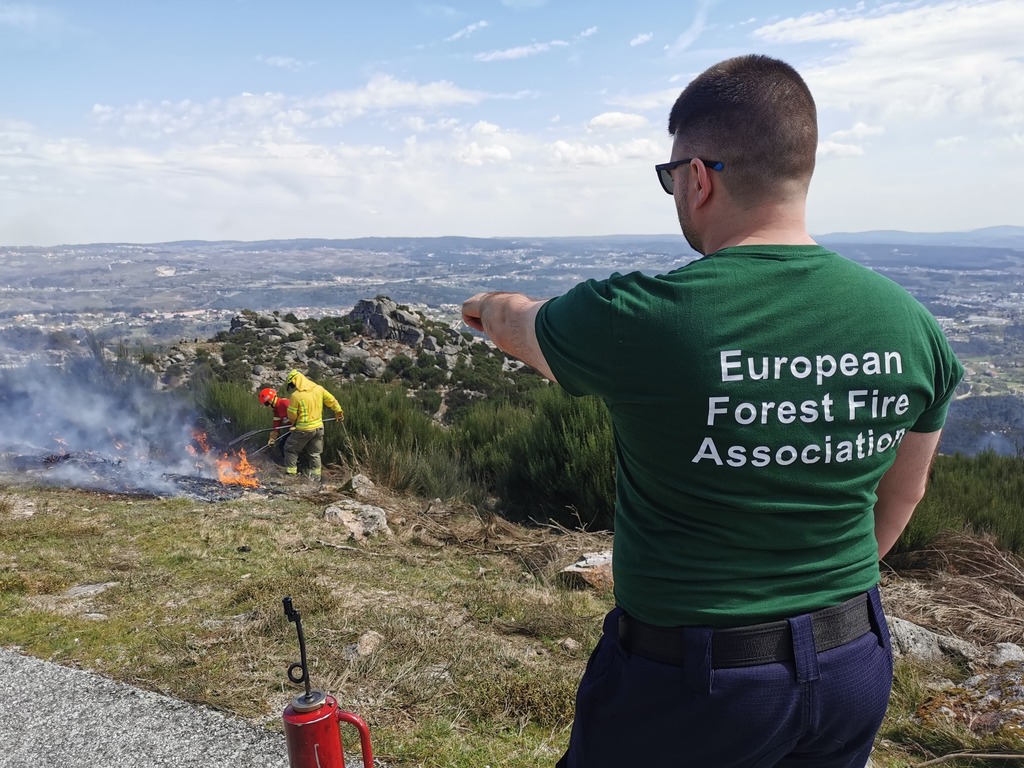
Discussions about firefighting clothing often revolve around tradition, uniform appearance, or visual identity. In wildland and vegetation firefighting, this perspective is insufficient. Here, the choice of personal protective equipment — and especially its color concept — is not a matter of style. It is a direct safety factor that influences visibility, recognition, coordination, and ultimately the protection of lives.
Wildland fire environments are defined by smoke, dust, ash, complex terrain, and rapidly changing light conditions. Under these circumstances, the human eye does not perceive colors the same way it does in everyday daylight. Color discrimination decreases, while brightness contrast and luminance become dominant. Colors that appear striking in normal conditions can lose their signaling effect quickly once smoke thickens or daylight fades.
From both physiological knowledge and operational experience, a clear principle emerges: maximum visibility must outweigh aesthetic or traditional considerations.
The human visual system is most sensitive in the yellow-green range of the spectrum. Tones in this range remain perceptible longer as light levels decrease and continue to stand out even when visibility is degraded by smoke. This is not theoretical — it is the reason why high-risk professions worldwide rely on these colors for warning and rescue applications. In wildland firefighting, such tones provide a level of detectability that darker or traditional colors simply cannot match.
Fluorescent orange plays a complementary role. Against vegetation, soil, and dry fuels, it creates strong contrast and is rapidly detected in daylight and moderate smoke. Its performance may diminish in very dense smoke, but in many vegetation fire scenarios it remains one of the most effective signal colors available.
Color alone, however, is never sufficient. As operations extend into dusk, night, or shaded terrain, retro-reflective materials become essential. When illuminated by vehicle headlights, headlamps, or scene lighting, reflective elements can remain visible through smoke even when color contrast alone fails. Without retro-reflection, light or white surfaces offer little real safety benefit.
Traditional firefighting colors present clear limitations in this operational context. Red loses brightness rapidly at dusk and appears dark or grey at distance. Beige and classic yellow tones soil quickly and often provide poor contrast in dry or burned terrain. Dark colors such as black or dark green blend into vegetation and shadow unless supported by strong signal elements. For modern wildland operations, relying on these colors alone no longer meets reasonable safety expectations.
This has led to a shift in contemporary PPE concepts. Increasingly, agencies adopt subdued base colors that suit the operational environment, combined with deliberately placed high-visibility signal areas and reflective elements. Visibility is not created by surface area alone, but by contrast — contrast against terrain, smoke, and changing light.
One factor is still frequently underestimated: helmet color. From the air, the helmet is often the most visible part of a firefighter. For helicopter crews and fixed-wing pilots operating at higher speeds, rapid recognition of ground personnel is critical. In recent years, black helmets have gained popularity for aesthetic reasons. In wildland firefighting, this trend is problematic. Black provides minimal contrast against burned ground, shadows, or dark vegetation and is difficult to detect from above — regardless of clothing color.
Bright, signal-strong helmet colors, supported by reflective elements, significantly improve aerial visibility and directly contribute to safety during air-supported operations. This applies not only to helicopters, but also to faster-moving aircraft where reaction time is limited.
In conclusion, the color concept of PPE in vegetation firefighting is not a fashion statement. It shapes visibility, perception, and safety under extreme and dynamic conditions. The same applies — decisively — to helmet color, particularly where aerial resources are involved. Modern equipment decisions should therefore be guided by human visual perception and operational reality, not by tradition or design trends. In wildland firefighting, being seen is not optional — it is fundamental.
No responses yet